


Malaysia presents a prime opportunity for Master’s students, with its rapid economic growth and rising higher education system. Positioned among the leading Southeast Asian countries, Malaysia has made significant strides on the global front in the 21st century.
For postgraduates, Malaysia is an enticing destination, offering numerous English-taught programs across a variety of institutions. Our website features a wide array of Malaysian Masters degrees for you to explore. For those eager to dive deeper into postgraduate studies in Malaysia, this guide provides essential insights.
Postgraduate Prospects in Malaysia – 2025 Overview
The Malaysian Ministry of Higher Education (MOHE) actively seeks to attract international postgraduate students to bolster the country’s academic research and global recognition. Consequently, many Master’s programs in Malaysia are conducted in English, with over 80,000 international students already enrolled in Malaysian universities.
Malaysia offers advanced postgraduate education in high-tech Science and Engineering fields. Additionally, the nation’s rich natural resources, including some of the world’s oldest tropical rainforests, provide a unique backdrop for pioneering research in Ecology, Medicine, and Natural Sciences.
Reasons to Pursue a Master’s Degree in Malaysia This Year
- Robust Economy: Malaysia’s economy has been on an impressive growth trajectory, with profits from the thriving business and high-tech sectors being funneled back into higher education and research.
- Affordability: Not only are tuition fees relatively low, but the overall cost of living in Malaysia is also budget-friendly.
- Safety and Stability: Malaysia offers a peaceful and politically stable environment, ensuring a secure setting for your postgraduate studies.
-
Global Campuses: The establishment of campuses by several foreign universities in Malaysia in recent years is a testament to the high quality of its higher education sector.

Malaysian Universities
Malaysia's higher education system is rapidly evolving, featuring both public and private universities, along with numerous international campuses formed in partnership with foreign institutions. While various institutions offer postgraduate programs, public universities confer the majority of Malaysian Masters degrees.
- Public Universities: These institutions receive government funding but operate autonomously, managing their own teaching and research. Public universities have achieved significant success in both regional and international rankings.
- Private Universities: Emerging since a 1996 act, private universities are funded by independent organizations. Despite their relatively recent establishment, their program quality is overseen by branches of the Malaysian government.
The rise in international branch campuses underscores Malaysia's commitment to partnering with global research institutes, attracting international students, and contributing to worldwide research initiatives. Masters programs offered at these campuses might be accredited either by the Malaysian host institution or the overseas partner, based on each campus's specific arrangement.
Accreditation of Malaysian Master's Degrees
The overall quality assurance for all higher education institutions in Malaysia falls under the jurisdiction of MOHE, with the Malaysian Qualifications Agency specifically overseeing postgraduate degrees. For detailed information about accreditation and quality assurance of Malaysian Master's programs, you can visit the Malaysian Qualifications Agency website.
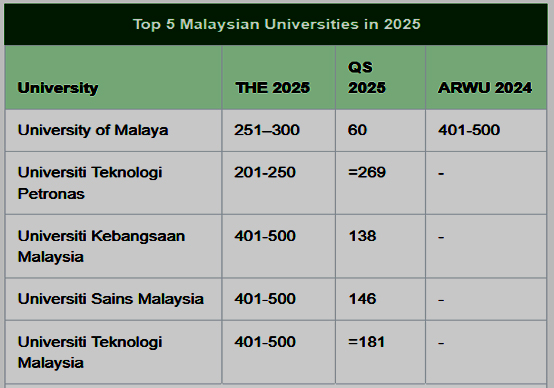
Malaysian University Rankings
Malaysian universities consistently rank well in the three major global ranking tables, with several institutions making it into the top 300 of the QS World University Rankings. Considering the relatively small size of Malaysia's higher education sector, its impressive performance on the global stage is noteworthy.
Course Types
The structure and assessment of Malaysian Master's programs vary. Some follow the familiar international format, with semesters of coursework and assessments followed by independent research projects, such as dissertations. Others focus on a broader array of taught units instead of a dissertation but still include independent study and group projects, catering to students aiming for diverse career paths. Malaysia also offers MPhil and PhD programs, which are predominantly research-focused.
Regardless of the type of Malaysian Master's degree you pursue, you'll need to earn a specified number of credits to qualify. Most Master's programs require completion of units worth at least 42 credits, with each credit representing 20 to 30 hours of formal study. Programs with a dissertation component generally allocate six or more credits to this part of the course.
The academic year in Malaysia consists of two teaching semesters, running from January to May and June to November, with short breaks in between and a longer holiday from November to January. The duration of a Malaysian Master's program is typically measured in semesters, ranging from one to three years depending on the specific course and subject area. Part-time or distance learning students may take slightly longer to complete their studies.
Fees and Funding for Master's Degrees in Malaysia
The tuition fees for Malaysian Master's programs are generally more affordable compared to other postgraduate study destinations. Various funding options are available for Master's courses in Malaysia, with the Malaysian government particularly motivated to enhance research outputs and boost international prestige through investing in its universities.
The exact costs will differ depending on the university and the subject area. On average, international students can expect to pay between MYR 18,609 and 32,556 (USD $4,000-7,000) at a Malaysian university.
Typically, fees at international campuses in Malaysia are higher than those at local institutions.
Funding
Funding for Master's programs in Malaysia comes in various forms. Universities might offer fellowships and scholarships from their own funds and endowments to support postgraduate students. These typically cover full tuition fees and living expenses but are awarded based on merit and can be highly competitive.
In some cases, you might also be able to secure an assistantship within your department, receiving payment in exchange for teaching, demonstrating, and administrative duties.
While these opportunities are more common for PhD students, advanced Master's students may also have access to them in certain cases.
The Malaysian Ministry of Higher Education also provides two generous scholarship programs for international students wishing to enroll at a Malaysian university.
Malaysian International Scholarship (MIS), aimed at talented international postgraduates in certain subject areas- Commonwealth Scholarship and Fellowship Plan (CSFP), awarded to nationals from the Commonwealth countries
Applying for a Master's in Malaysia
Malaysia does not use a central admissions system, so you will need to apply directly to the universities for a Master's degree. Each institution will have its own admissions requirements for postgraduate programs, but all will require you to have an undergraduate Bachelor's degree in a relevant field. If you do not have a Bachelor's degree or its equivalent, you may still be considered if you can demonstrate significant professional experience.
Additional entry requirements for Malaysian Master's programs are determined by the individual universities. Most will seek evidence of your enthusiasm and capability for postgraduate study. Typically, this includes providing a personal statement detailing your academic background, research interests, and any relevant professional or work experience. In some cases, you may also need to submit academic transcripts and references to support your application.
You may also need to have your existing degrees recognized and accredited by the prospective university in Malaysia. This process is usually straightforward for undergraduate qualifications from well-known higher education systems.
Language Requirements
While Malay is the official language of Malaysia, there has been a significant push to attract foreign students, leading to the introduction of numerous English-language Master's programs at Malaysian universities. If English is not your first language, you may need to take an academic English test. Malaysian universities generally accept international language tests like the TOEFL and IELTS. Typical minimum scores required are around 60 for the TOEFL internet-based test and between 5.0 and 6.5 for the IELTS. Specific language requirements and other criteria will be provided by the individual universities.
Visas for Master's Students in Malaysia
All international students aiming to pursue a Master's in Malaysia must undergo an immigration process. Initially, you'll need to apply for a Visa Approval Letter (VAL) through the Malaysian Immigration Department. Once you obtain this document, you can plan your travel to Malaysia.
Upon arriving in Malaysia, you must present your VAL at the airport, where authorities will stamp your passport, allowing you to stay in the country to complete the next step in the visa process: obtaining a 'Student Pass'.
Typically, you'll apply for the Student Pass through your Malaysian university, which will then be processed by the Malaysian Immigration Department.
To acquire a Student Pass, you'll need the following:
- A photo
- A copy of your passport
- An offer letter
- Health declaration form
- Your academic certificates and transcripts
- Personal bond (through the university)
- English language test
The processing fee for the Student Pass is MYR 2515 (USD $560.45) and is non-refundable, although some institutions may be eligible for rebates. Additionally, you may need to pay MYR 579 for subsequent document processing, which is refundable if the application is unsuccessful.
For more detailed information about visas and immigration for Malaysian Master's degrees, visit the Education Malaysia Global Services website, the official study portal for international students in Malaysia.


